Summer drew its final breath in the Dutch capital. The sun sets earlier now, around 5:00 in the afternoon, and does not rise before 7:30 in the morning. Temperatures have dropped from above 20 degrees Celsius to below 10. There hasn’t been any sort of “smooth” transition between summer and autumn – which looks more like winter to me. Except that we were lucky for the last few days. This kept me wary about the coming months of January and February, when winter actually sets in with a vengeance from what I hear. Brrrrr! It’s going to be cold. You’ve got to understand that for a Mediterranean sun-worshipper like me, this is cause for considerable concern. I mean, people in my country are still hitting the beach in October. Rain doesn’t start falling before December.
However, now that I’m in Amsterdam, I have decided to embrace the weather. Testament to my vast amounts of courage is my solid decision to go out no matter what. But we will see how I feel when it drops below zero. The chilly, windy and wet autumn season reminded me of a Lebanese friend who stayed for a few years in The Netherlands. He had a tendency to spend his time indoors, probably huddled in blankets sneezing his way through the afternoon, whenever the weather was cold, dark and gloomy. So you know. A lot.
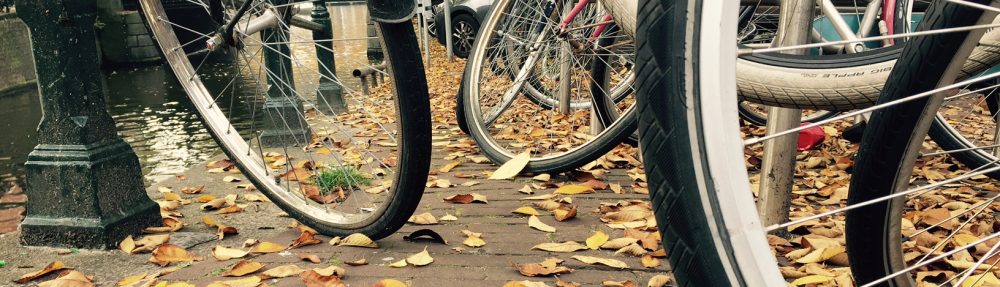
Obviously this isn’t the case for the Dutchies; nothing can stop them from going out and riding their bicycles whether rain or wind or ice. So I did what everyone else does, “occasionally” took my bicycle instead of the tram, but without managing to hold an umbrella at the same time. I haven’t mastered that yet. Maybe global warming will turn Holland into a sun-lover’s paradise before I do that trick. Until then, I am enjoying the most beautiful of seasons.
**Autumn in Amsterdam is marked by golden colours, cosiness, good food and culture (i.e: Museum night).
One of the advantages of freedom of movement and open borders is the possibility to book last minute trips and travel around Europe. Or the world, even – but only if you are lucky enough to have a Western passport and thus can get visas on arrival to practically anywhere. As someone who comes from Lebanon, a small country bordered by war-torn Syria on one side and a not so friendly neighbour Israel on the other, I love my newfound luxury to travel freely to various European cities.
The Lebanese passport does not make things simpler. Its current global power rank is at 85, same as North Korea according to the passport index list for 2016. This gives you a pretty good idea on the bureaucratic “torture” Lebanese citizens have to endure to be allowed into almost any other country- unless of course, they hold a second passport from the US or EU, which many do. Being Lebanese means having to apply for a visa (long) in advance, through foreign embassies in Beirut, for almost every destination EU citizens can just hop on a plane to. Only 39 countries, which you can find here, give us a visa on arrival.
Some Lebanese blame it on the Lebanese Minister of Foreign Affairs and Emigrants who, they say, is not doing his job including, but not limited to promoting and maintaining positive diplomatic relations with other countries. Others say it’s because of Hezbollah who, let’s face it, dominates many of the Lebanese government’s decisions and is not appreciated by a considerable number of countries worldwide. But I won’t linger on this. What matters here is that I used my access to those open EU-borders to have a short hop of my own, to pretty Milan and Bologna!
Italy was the first European country I ever visited. I was fourteen when our high-school director organised a two-week trip to Rome, Florence and Venice. More than fifteen years later I went back to visit other Italian cities. All I had to do this time, was show my Dutch residency and get on the plane. It was probably the smoothest trip I’ve ever had. Although an hour and a half away only, temperatures were considerably higher, making me feel right at home; it was an actual real summer. During the six-day trip, all we did was walk around, visit museums and of course churches, attend musicals, eat and drink. In order to avoid putting on two or three kilos, I highly recommend you do a lot of walking; enjoying the Italian cheese and charcuterie delicacies at the many ristorante, trattoria and osteria comes at a high price.
Between Milan and Bologna, I fell for the latter: the small streets, the pinkish and yellow buildings, people’s generosity and sense of humour. Bologna is a very charming place, away from drunk and loud tourists. Calmer locals, calmer tourists, calmer everything. But most of all, the Italian language. It is simply so beautiful to listen to that you end up speaking English with an Italian accent. I’ll definitely go back to Italy again soon.
Yes I did. And no, I wasn’t that desperate to get married, especially to this guy. Because obviously marrying the next-door neighbour makes it to the top of the list of romantic clichés. But it is not everyday that I run into a good-looking super-blond dude on the stairs at 1 A.M., asking me for a lighter. And then inviting me for a bottle of wine (a bottle!) at his place, full of confidence. (Again: one in the morning!) That night, we ended up chatting for a bit at my doorstep and we agreed that it would be a less upfront idea to meet for a coffee during the day. The month that followed witnessed frequent knocking on my door for sugar, salt, lemon, olive oil, painkillers, you name it. Then the handsome neighbour moved to a different part of Beirut. Three months after, we started dating and I insisted we keep it light and simple, no serious business. Three years later we got married. Last weekend we celebrated our one-year anniversary in Amsterdam, the blond dude’s home town.
And what better way to celebrate love than with music. We made our ‘katoenen huwelijk’ a three-day Dutch-musical-festival-integration-fest. With a couple of beers on the back of the bicycle, we headed to Frankendael Park, east of Amsterdam where Tchaikovsky’s Pique dame (Queen of spades) was broadcasted on a big screen, live from the National Opera & Ballet. The three-hour opera revolves around the obsessive desire for becoming rich through gambling. Aside from the story plot, I was fascinated by the beauty and clarity of sounds, their dramatic intensity and resonance filling the open air. It was sunny and warm after a week of constant rain. Those who arrived early found a place to sit. Those who were late, rested on picnic blankets drinking wine and soaking up the sun.
The next day we headed to another kind of music performance in Wormerveer – a small town 23 minutes away from Amsterdam. How did I end up there? Well, a friend was playing in a band and we wanted to see her. When we arrived, we saw a completely different crowd. People watching the opera the day before in the park had an intellectual, upper-classy look. Today, the audience seemed to be from the work hard, play hard crowd. Many looked like working-class middle-aged men and women, and most sported tattoos, piercings and/or dreadlocks. The location of the festival used to be a squat. Leftist and anti-fascist signs were still hanging on the walls inside the bar. What I thought was a meat sandwich at one of the kiosks turned out to be a falafel. I didn’t recognise it, but that’s what they called it. There was only vegetarian food.
Although I felt a little strange and out of place, there was something very genuine about these people. They seemed tough; like whatever life throws at them they’ll take. The festival was small but a lot of fun. There were five bands, mostly local, except for the one band a friend of ours played the drums in: Le Garage from Utrecht. It’s a little like a Dutch version of the (awesome!) Lebanese Wanton Bishops. Their music was mostly alternative blues/rock with a deep delivery of rhythm and blues. We danced till sunset – which means 10:30 P.M here, this time of year.
Later that weekend, as part of my integration and assimilation process with the local culture (smiley!), we did what many Dutch people are obsessed with whenever the rain stops and the sun pops out for a moment: go out and play! Our last stop on this musical weekend was at Parkpop in the Hague, one of the biggest free pop festivals in Europe. There were four stages with continuous national and international bands of all kinds. And to my surprise, K’s choice – my favourite Belgian band – was playing. It reminded me of my evening runs at the Corniche near the sea in Beirut, when I used to listen to “Not an Addict”, one of their best-known songs. There were more than 270,000 visitors at the Parkpop that day, from different nationalities, backgrounds and musical preferences. They got together with no trouble at all. No fights, no accidents whatsoever (although I understand that’s not always the case). Everyone was enjoying the music, the food and the cold beer.
The anniversary weekend ended with a romantic brunch that my sweet husband prepared: a cold bottle of Prosecco, strong and smooth warm coffee, tasty salmon, succulent parma ham, fresh bread and juice, sunny side up eggs, a variety of fruits and of course the yellow Dutch cheese (yummy). It was perfect.
I was doing well back home in Beirut. I had what I thought was all I needed: a loving family, wonderful friends, a great job. Everything seemed perfect in my own little circle. But it was a circle that I had created, like many other Lebanese, to shield myself from the dysfunctional mess around me. Finally, I couldn’t keep the outside out anymore. So I tried my luck here in Amsterdam. And what a change it’s been.
Beirut was my city. It’s chaotic, and full of character. It blends the old with the new, the rich with the poor, the Arab world with the West. Its streets and suburbs are a colourful mess: shiny new sky scrapers mix with traditional two-story houses and pitiful shacks. It is on the Mediterranean, so with the smell of salt a feeling of freedom continually washes over the city. And it’s true: Beirut is open, tolerant, even liberal compared to the rest of the Arab world. At least, in my circle it is. Its character is fuelled by its people, talented, creative, smart, hip, but also deeply disturbed, to be honest.
I love Beirut like you love a destructive lover, who keeps you hanging on with hints of how it could be, how it should be. Until the moment you realise you have to leave, if only to maintain your health and sanity.
So here I am, taking a walk on a sunny Amsterdam day along the dozens of waterways and canals, heading toward Oost. I sit on a bench for a long time listening to the sound of the light breeze through the long trees, watching a couple of ducks float on the water, enjoying the summer sun as the tram bells echo in the background. Everything is so peaceful, so clean. I think of when I started learning Dutch in Lebanon and how surprisingly fun the classes were. Then I remember the day I learned my residency was in order, and how ready I felt to go.
Beirut does not have an easy past. After a 15-year long civil war which left so much destruction on its buildings and in the hearts of its population, its problems now are more mundane: lack of water, power cuts, pot-holed roads, suffocating traffic, and not a single publicly accessible park worth the name. An ongoing trash crisis – the result of incapable, corrupt, money-hungry politicians – has made the streets of Beirut smell like a garbage dump for the past year, with no solution in sight (despite creative and angry protests). And then there are the more than 1.5 million Syrian refugees (on a Lebanese population of 4 million), which is putting extreme pressure on the already weak local infrastructure and public services. Religious and political tensions, staggering economic and social inequality – it’s all widening the gap between the rich and poor.
It all seems so far away here, as if I’ve driven into a morning fog on a dark forest road and came out on the other side in daylight. Amsterdam feels magical, like a dream, with its incredibly beautiful architecture and lit canals. And the green; I can’t emphasise enough how great it is to be able to access parks for free, just sit there, read, spend time with friends or exercise in the morning in the fresh air. Nothing can beat a bicycle ride – no matter how challenging it may look with all the confused tourists around – through the endless small streets feeling the wind on your face. It’s ultimate freedom. Everything works. While this may seem like a fact-of-life for those living in a developed country, it makes me realise the collective commitment and effort that have been put into it, to have a well-functioning society. Every detail has been thought of: the alignment of trees on the sides of the roads, bike lanes, parking spots, parks, where to stick posters (RIP, Johan Cruyff) and ads, where to post your mail, how to sort the trash, where people with disabilities can go, children, bus stops and the list goes on and on. I was even able to become a fiscally legal ZZP’er (self-employed person with no personnel) in less than a month. This is a miracle!
I love Beirut’s generosity, its hospitality, how it embraces you and makes you feel home, welcome. But after years of disappointment, I had to leave; because I want to build a stable life and make a new place home. So here’s my first post on the struggle to achieve that in Amsterdam. There are problems too – the hardness of society here is one. But more on that later. I’ll keep you posted, those of you going through the same process, or Dutch people interested in what it’s like to arrive here, while I wonder about my new life, in this new city. Hopefully, this one will make a better lover.


 Life in Orange
