Vandaag heb ik voor de eerste keer in mijn leven gestemd. Niet in Libanon, waar ik vandaan kom, maar in Nederland. Vier jaar geleden, toen ik net naar Amsterdam was verhuisd, kon ik niet stemmen. Ik twijfelde tussen GroenLinks en D66. Dit jaar heb ik naar bijna alle debatten tussen de verschillende partijen en hun programma’s gekeken. Ik twijfelde nog: ga ik voor PvdA, die hun stemmers in de vorige jaren teleurgesteld hebben? Of voor GroenLinks? Die zijn te “politiek correct” en dat lijkt me soms onrealistisch. Of D66, die om eerlijk te zijn oorspronkelijk mijn voorkeurspartij waren?
Nee, niet met Sigrid Kaag als lijsttrekker. Toen ze in Libanon werkte als UN Special Coordinator for Lebanon, heeft haar bureau een e-mail gestuurd naar alle VN werknemers (inclusief mijzelf) om ons te verbieden om een deel te nemen aan de betogingen tegen de corruptie van de Libanese regering in 2015, en hun slechte aanpak van de afvalcrisis. Dit vond ik ondemocratisch en een beetje hypocritisch van haar. Als Libanees had ik het recht om te demonstreren. Dit zou niet in Nederland gebeuren bijvoorbeeld. Ik had ook hetzelfde gevoel toen ik naar één van Kaags interviews luisterde: ze zei dat het ze geen nee kon zeggen tegen een ‘eerste’ baan bij Shell, ondanks dat dit bedrijf activiteiten had in Zuid-Afrika tijdens de apartheid. Dus voor mij was ze niet iemand die echt staat voor principes. Het ging over de omstandigheden; dit is de houding van diplomaten. Een partij leider is geen diplomaat maar een politicus.
Voor wie heb ik dan gestemd? Volt. Een nieuwe partij die net is begonnen in de politieke sfeer en die Europa steunt. Daarin geloof ik, vooral om dat ik uit een erg verdeeld deel van de wereld kom. Een sterke EU is belangrijk voor de groei van Nederland. Ik wil ook een kans geven aan een groep mensen met nieuwe ideeën, net als ik een kans kreeg toen ik naar Nederland kwam.
What a rewarding feeling to know that your vote can and will make a difference. An essential process in any real democracy in the world.
Imagine you’ve finished work on a Tuesday afternoon, and three hours later you suddenly find yourself in a different country. All you need to do is hop on a train from Amsterdam to the medieval Belgian city of Ghent – or ‘Hent’, as pronounced in Flemish which is a very cute version of Dutch. No borders, no customs and no need for a visa – something that I, as a Lebanese, can’t help but appreciate every time (Lebanon borders two countries: one is impossible to enter “Israel”, the other is too dangerous “Syria”. We also need a visa to almost every other country in the world).
Although I had booked a couple of weeks earlier, the day before traveling was a little stressful. I got annoyed for the first time with NS, the national public transportation sector here – for once joining the big chorus of Dutch complaining about their national rail road (although I still think that it’s pretty good, normally). Their website mentioned delays due to works on railways. It did not give alternative times or routes to take, particularly for those making international travels. Eventually, it all went well and we made it in a very short time.
Once in Belgium, and although borders have been open for decades, the scenery still changes in subtle, but sudden ways. Colors of trees and houses become completely different so does the shape of inner city roads. It all looks less identical and orderly compared to The Netherlands. Arriving to Ghent feels like walking into the 13th century, when most of its buildings were constructed, and then back into the 21st century with all its modern restaurants, cafés, museums, markets and shopping districts. Locals are very friendly and welcoming. Prices are affordable, food is exquisite; I had the best steak ever, and there is lots and lots of beer: hundreds of flavors and suggestions to match your meal perfectly (So you get beer instead of wine suggestions with your meal – wonderful).
I ended up visiting the same places over and over. Cour St Georges or Sint-Jorishof was one of my favorites. A steakhouse throwback to the middle ages. Wooden floors were covered in quilt, skins of some hunted animals were hanging on the walls and liter sized clay pots of beer stood on the shelves of the bar. A room on a higher floor is dedicated to smokers – one would imagine a group of rowdy horsemen smoking pipes and drinking pints of ale. You can either order a normal portion size from the menu or pick your piece of meat from a large display in the vitrine. We ended up sharing a 350 grams of beef steak with two liters of beer and a large bowl of fries.
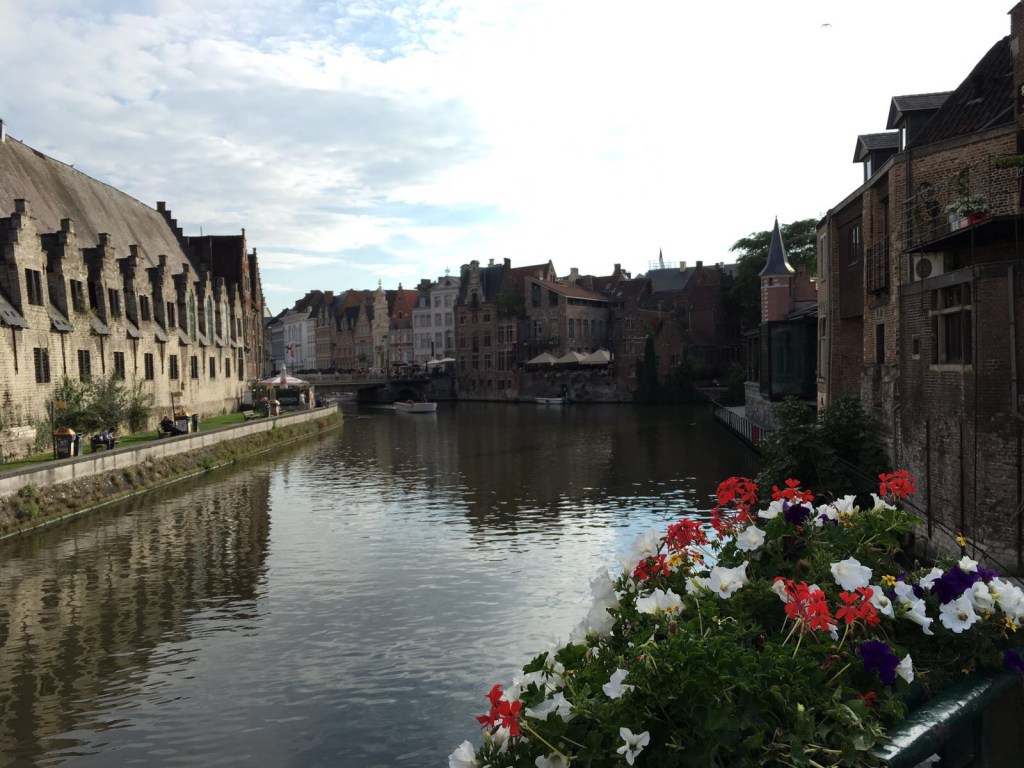
Another nice spot for dinner or lunch is restaurant de Graslei. It offers a great view over the colorful old buildings of Ghent on both sides of the canal. We tried the “moules et frites” seasoned with fresh garlic, obviously. It was delicious. Although I don’t recommend eating chunks of garlic for dinner. I ended up smelling like garlic for two days (and, I’ve been told, burping out fumes throughout the night). Not very classy.
Before leaving Ghent, we had to visit Gentse Gruut or the city’s brewery. There, you can actually have beer tasting, get a walking or boat tour to know more about its history. After your visit, the short tasting session you had helps you learn about various beers and their characteristics. Then you can create your own beer as a beer alchemist. As we showed up about 30 minutes before closing time and thus missed the 3-hour beer walk, we only made it to the degustation part where you’re offered five different kinds of beer in small glasses. I returned home quite satisfied (and appie!).
There are many small bars in the city but Café t’ Galgenhuis is the smallest, oldest and most “gezellig” in Ghent. Behind its small roof, public humiliation or shameful exposure of prisoners and offenders took place. Apparently, this was immensely fashionable in the Middle Ages. Used usually to punish less serious crimes, the show offered viewers the opportunity to shout or throw things at those accused. Both physical and verbal abuse could be inflicted. Prisoners were held in a pillory, a device made of a wooden or metal framework with holes for securing the head and hands. Now you can just sit outside on the terrace and enjoy a cold glass of beer in the sun. This was our late afternoon ritual in the couple of days we spent in the city. Throwing it at people is no longer allowed.
We found several impressive churches in Ghent, but just like many European cities, most holy places are now serving other purposes: theatre, festivals, exhibitions and food markets. The Holy Food Market in Ghent used to be a chapel that goes back to the 16th century but was transformed into an indoor food court with various food stands including Lebanese mezze. Make no mistake dear believers, almost everything in there takes into consideration religion, but now as foodies’ religion. You’ll find a holy gin bar, holy Malaysian cuisine, a Magnum pleasure store, a Karnivoor stand for meat lovers and Yalla Yalla Beirut street food among others. Once you finish, a sign at the door asks you to please the lord and clear your table.
It’s almost midnight and you don’t want to go home, because you’re on holiday. Mosquito Coast is where we ended up almost every night. An unconventional alternative cafe with old stickers and posters on the walls. Various photographs and souvenirs from different parts of the world are displayed in the corners of the restaurant. Many go back to Congo, a former Belgian colony. Here you can find Belgian beer of course, and all the delicious cocktails you can drink to cool down and get to sleep in the hot summer nights – which do not occur often enough in Northern Europe.
Good wine, good food and good company are some of life’s most civilised pleasures, someone said. Add to that warm weather and Fado music and you’ll find yourself in Lisbon, one of the most underrated cities in Europe. If you appreciate the simple joie de vivre like me, you must visit this beautiful Portuguese city.
Time moves slowly and days feel longer, in a good way. People enjoy the warm, crisp evenings until well into the night, at least they did during my September visit, but still manage to go to work in the morning. During my short holiday, I made sure not to get up so early. My day started around ten with a short hop to the nearby bakery for coffee and delicious pastries, particularly pastéis de nata, my favourite. Then I was back to my small cozy apartment on the foot of one of Lisbon’s many hills to enjoy my sweet breakfast. Using Airbnb allowed me a glimpse of how locals live. After spending a week, people in my street started greeting me as if I’d always been living in the neighbourhood.
Around noon, it is time to go out. Take one of the small and colourful trams that regularly go up and down the hills overlooking the water. Head to a viewpoint, or a miradouro, as the Portuguese call it. Each offers wonderful views: monumental architecture and buildings often decorated with blue, white or green ceramic tiles brought by the Moors in the Middle Ages; panoramic scenery; the city’s port; and the 25 de Abril Bridge, a smaller version of the Golden Gate Bridge in San Fransisco. Grab a drink and have a long break.
Getting hungry yet? I am. Alfama, the oldest district of Lisbon, has many places that serve traditional Portuguese gastronomy as well as international cuisine. I felt right at home, with the Portuguese custom of eating various small plates of food. Petiscos, similar to the Spanish Tapas and my own beloved Lebanese Mezze. And of course: Vinho Verde, the unique made-in-Portugal-only green wine; young, cool, summery, light and low in alcohol.
While walking around the streets of cobblestone in Lisbon, I made regular stops on the long stairs to look at the buildings. In some areas the difference between various constructions was staggering; completely renovated apartments with shiny ceramic tiles on their facades, standing next to almost crumbling houses with broken shutters and no windows. When I asked for the reason, I was told that many often elderly tenants pay extremely low rents, frozen by an old law decades ago. So the owners can’t afford upkeep, buildings are in shambles. It reminded me of Beirut: some policy set in motion at some point because it served some populist politician, or even seemed wise at the time, but nobody bothered to look at the long-term consequences.
The last economic crisis hit the country hard. Although it is recovering very slowly, many elderly have to live off pensions 250 or 300 euros a month, which allows for very little. Youth unemployment remains high, many people beg on the streets, people complain about corruption in various official departments. That’s how locals explained their current situation, a big contrast with the more prosperous Northern Europe. But I am no expert on Portugal, merely an observer and obviously a curious listener to whatever the locals have to tell about their country.
I still loved the vibe in Lisbon. It feels way more leftist and hippie than in Amsterdam: more graffiti, young people never seem to be in a rush, the streets are full with endless kiosks, small casual restaurants and bars – rather than luxurious or sophisticated diners – prices are affordable. The coast is lined with a sandy beach, the water looks super clean. It is the perfect location to watch the sunset. Grab a glass of cold Sangria and sit on a bench to enjoy the amazing tones of orange, pink and yellow.
All in all, an ideal destination for a long and relaxing stay.
*Ginja is a sweet cherry liqueur that originated in Lisbon. You can drink it in a small chocolate shot and the trick is not to eat the shot in order to have a refill. It’s terribly good.
One of the advantages of freedom of movement and open borders is the possibility to book last minute trips and travel around Europe. Or the world, even – but only if you are lucky enough to have a Western passport and thus can get visas on arrival to practically anywhere. As someone who comes from Lebanon, a small country bordered by war-torn Syria on one side and a not so friendly neighbour Israel on the other, I love my newfound luxury to travel freely to various European cities.
The Lebanese passport does not make things simpler. Its current global power rank is at 85, same as North Korea according to the passport index list for 2016. This gives you a pretty good idea on the bureaucratic “torture” Lebanese citizens have to endure to be allowed into almost any other country- unless of course, they hold a second passport from the US or EU, which many do. Being Lebanese means having to apply for a visa (long) in advance, through foreign embassies in Beirut, for almost every destination EU citizens can just hop on a plane to. Only 39 countries, which you can find here, give us a visa on arrival.
Some Lebanese blame it on the Lebanese Minister of Foreign Affairs and Emigrants who, they say, is not doing his job including, but not limited to promoting and maintaining positive diplomatic relations with other countries. Others say it’s because of Hezbollah who, let’s face it, dominates many of the Lebanese government’s decisions and is not appreciated by a considerable number of countries worldwide. But I won’t linger on this. What matters here is that I used my access to those open EU-borders to have a short hop of my own, to pretty Milan and Bologna!
Italy was the first European country I ever visited. I was fourteen when our high-school director organised a two-week trip to Rome, Florence and Venice. More than fifteen years later I went back to visit other Italian cities. All I had to do this time, was show my Dutch residency and get on the plane. It was probably the smoothest trip I’ve ever had. Although an hour and a half away only, temperatures were considerably higher, making me feel right at home; it was an actual real summer. During the six-day trip, all we did was walk around, visit museums and of course churches, attend musicals, eat and drink. In order to avoid putting on two or three kilos, I highly recommend you do a lot of walking; enjoying the Italian cheese and charcuterie delicacies at the many ristorante, trattoria and osteria comes at a high price.
Between Milan and Bologna, I fell for the latter: the small streets, the pinkish and yellow buildings, people’s generosity and sense of humour. Bologna is a very charming place, away from drunk and loud tourists. Calmer locals, calmer tourists, calmer everything. But most of all, the Italian language. It is simply so beautiful to listen to that you end up speaking English with an Italian accent. I’ll definitely go back to Italy again soon.
I was doing well back home in Beirut. I had what I thought was all I needed: a loving family, wonderful friends, a great job. Everything seemed perfect in my own little circle. But it was a circle that I had created, like many other Lebanese, to shield myself from the dysfunctional mess around me. Finally, I couldn’t keep the outside out anymore. So I tried my luck here in Amsterdam. And what a change it’s been.
Beirut was my city. It’s chaotic, and full of character. It blends the old with the new, the rich with the poor, the Arab world with the West. Its streets and suburbs are a colourful mess: shiny new sky scrapers mix with traditional two-story houses and pitiful shacks. It is on the Mediterranean, so with the smell of salt a feeling of freedom continually washes over the city. And it’s true: Beirut is open, tolerant, even liberal compared to the rest of the Arab world. At least, in my circle it is. Its character is fuelled by its people, talented, creative, smart, hip, but also deeply disturbed, to be honest.
I love Beirut like you love a destructive lover, who keeps you hanging on with hints of how it could be, how it should be. Until the moment you realise you have to leave, if only to maintain your health and sanity.
So here I am, taking a walk on a sunny Amsterdam day along the dozens of waterways and canals, heading toward Oost. I sit on a bench for a long time listening to the sound of the light breeze through the long trees, watching a couple of ducks float on the water, enjoying the summer sun as the tram bells echo in the background. Everything is so peaceful, so clean. I think of when I started learning Dutch in Lebanon and how surprisingly fun the classes were. Then I remember the day I learned my residency was in order, and how ready I felt to go.
Beirut does not have an easy past. After a 15-year long civil war which left so much destruction on its buildings and in the hearts of its population, its problems now are more mundane: lack of water, power cuts, pot-holed roads, suffocating traffic, and not a single publicly accessible park worth the name. An ongoing trash crisis – the result of incapable, corrupt, money-hungry politicians – has made the streets of Beirut smell like a garbage dump for the past year, with no solution in sight (despite creative and angry protests). And then there are the more than 1.5 million Syrian refugees (on a Lebanese population of 4 million), which is putting extreme pressure on the already weak local infrastructure and public services. Religious and political tensions, staggering economic and social inequality – it’s all widening the gap between the rich and poor.
It all seems so far away here, as if I’ve driven into a morning fog on a dark forest road and came out on the other side in daylight. Amsterdam feels magical, like a dream, with its incredibly beautiful architecture and lit canals. And the green; I can’t emphasise enough how great it is to be able to access parks for free, just sit there, read, spend time with friends or exercise in the morning in the fresh air. Nothing can beat a bicycle ride – no matter how challenging it may look with all the confused tourists around – through the endless small streets feeling the wind on your face. It’s ultimate freedom. Everything works. While this may seem like a fact-of-life for those living in a developed country, it makes me realise the collective commitment and effort that have been put into it, to have a well-functioning society. Every detail has been thought of: the alignment of trees on the sides of the roads, bike lanes, parking spots, parks, where to stick posters (RIP, Johan Cruyff) and ads, where to post your mail, how to sort the trash, where people with disabilities can go, children, bus stops and the list goes on and on. I was even able to become a fiscally legal ZZP’er (self-employed person with no personnel) in less than a month. This is a miracle!
I love Beirut’s generosity, its hospitality, how it embraces you and makes you feel home, welcome. But after years of disappointment, I had to leave; because I want to build a stable life and make a new place home. So here’s my first post on the struggle to achieve that in Amsterdam. There are problems too – the hardness of society here is one. But more on that later. I’ll keep you posted, those of you going through the same process, or Dutch people interested in what it’s like to arrive here, while I wonder about my new life, in this new city. Hopefully, this one will make a better lover.




 Life in Orange