Have you ever watched sumo wrestling?
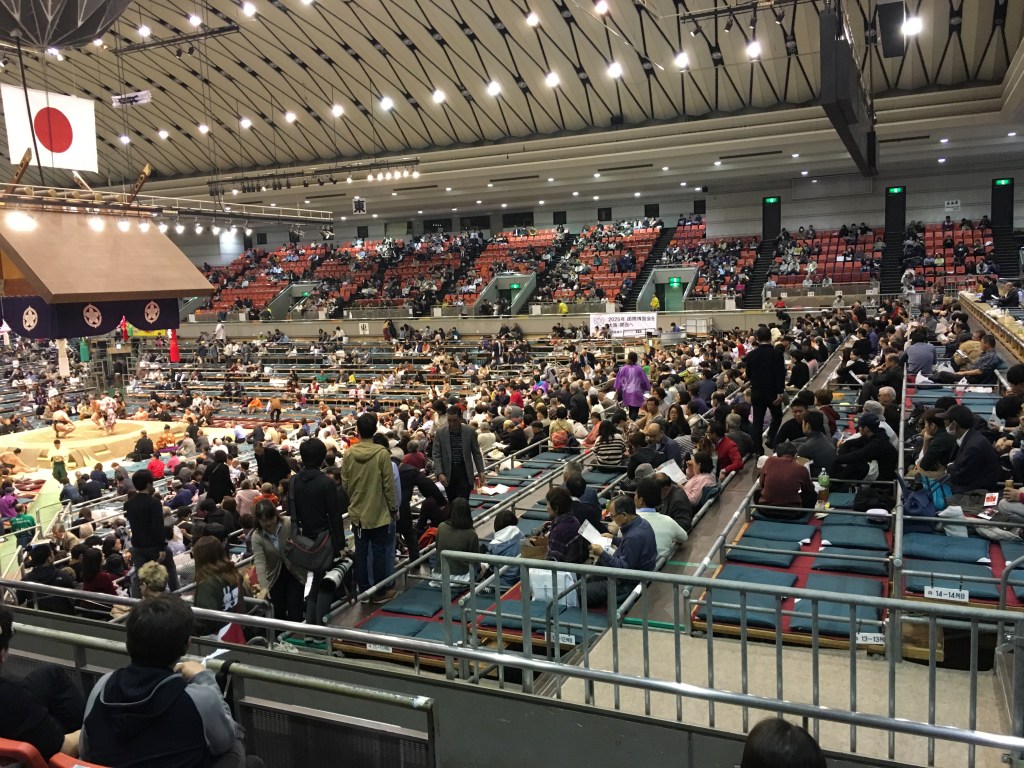
When I heard of the grand sumo tournament happening in Osaka I thought I needed to get tickets. They were sold out online so the only way was for me to get up early in the morning (five a.m.) and queue hoping for a ticket. And it worked!
The crowd started small at nine in the morning to watch junior fighters compete. In the afternoon more skilled and high-ranked wrestlers faced each other, which made fights more exciting. Those who had more wins than losses in the game moved up the hierarchy while those who lost got demoted. The winner was handed a closed envelop (probably cash) at the end of every match. I tried to get more information about the rules of the game from Japanese spectators. One big sumo fan university student explained that the game was all about “pushing” and “pulling”. In both cases, a player aims to destabilize another by either making him fall and touch the ground or kicking him out of the ring.
Sumo wrestlers had to put on weight and were asked in stables, which are accommodations where they lived and trained, to eat certain types of food and drinks including a high-in-calories stew. It is not until many of them suffered from diabetes and others died at the age of 65 (which makes sumo an unhealthy sport – ironically) that rules became a little more lenient. The concluding match took part that day late in the evening. After a long introduction of who the players were, their ranks and them posing with the mawashis they were wearing (check the photos below), it took only a couple of seconds before one of the wrestlers got thrown out of the ring. That was the end – I literally spent about 12 hours watching sumo wrestling waiting for the final match which ended in like 10 seconds.
While you’re in Osaka, Osaka castle is totally worth a visit. It is one of the biggest in size in Japan. Major battles between different clans including shoguns (rulers appointed by the emperor) were fought there. The castle has been destroyed several times to be rebuilt again, kind of symbolizing the rise and fall of the country’s history. The outer moat and tower give you an idea on how this building must have been besieged back in the 1600s.
Because no distance is too far in Japan, I made two trips from Osaka: to Kobe, which reminded me so much of the coastal city of Jounieh in Lebanon with its green mountains looking down onto the sea. I walked around its small hills where you can still see western designed houses. These go back to the 19th century when the city opened up to foreign trade – and Japan was forced to come out of its isolation. Most European style houses were inhabited by foreign merchants and diplomats. Starbucks managed to use one (damn it!)
When I walked into a local standing bar, waitresses and clients started cheering – a tradition that always makes you feel welcome and want to drink more. I had a couple of beers with two Japanese salarymen. Luckily one of them spoke English so I started bombarding him with questions about the country. He was very much pro-peace and said “although Japanese people have concerns about North Korea and China, most of them don’t want to go through war again”. This was in response to my question about article 9 – which is “a clause in the constitution outlawing war as a means to settle international disputes involving the State”. However, he was not happy with Japan “being dependent on other countries for its security or having several US military bases”. He recommended that I visit Hiroshima – which I was going to of course – and that I try the Kobe beef steak while I’m here. I did; medium rare with nothing more than pepper and salt. It just melts in your mouth with its soft, succulent flavor. The next day I took the early Shinkansen to Hiroshima, 330 Km away from Osaka (and back in one day!).




 Life in Orange